First Grand Property Management · Mauritius
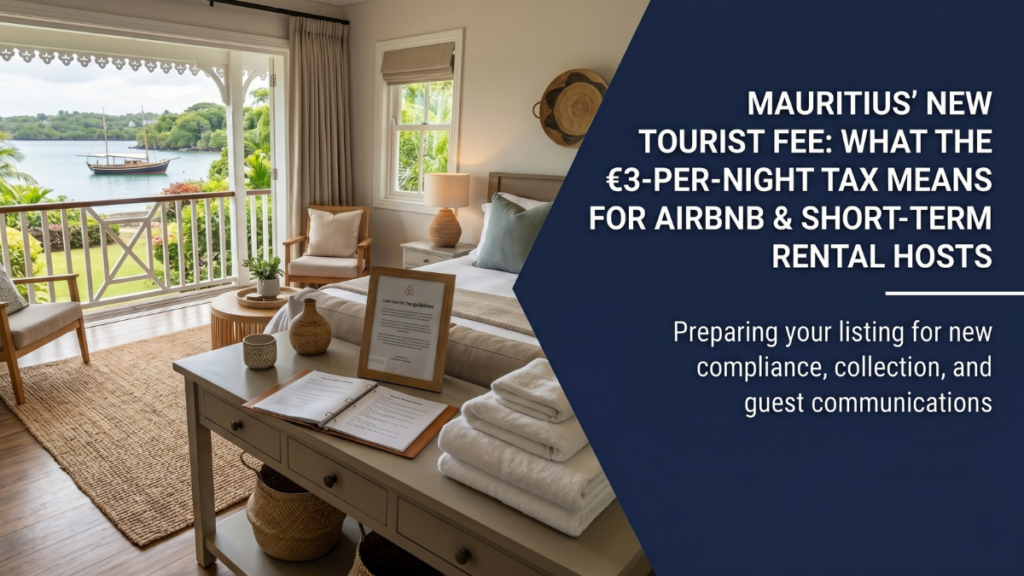
Mauritius’ New Tourist Fee: What the €3-Per-Night Tax Means for Airbnb and Short-Term Rental Hosts
From 1 October 2025, Mauritius introduced a new “Tourist Fee” of €3 per tourist, per night, for stays in registered tourist accommodation. If you are hosting on Airbnb, Booking.com, Vrbo or Agoda, this isn’t just a news headline — it changes how you price, collect and report revenue.
This article explains the tax in plain English and what it means operationally for short-term rental hosts, with a focus on Mauritius.
TL;DR — Key Takeaways
- Since 1 October 2025, Mauritius charges a €3 per tourist, per night Tourist Fee on registered accommodation, including short-term rentals.
- Hosts on Airbnb, Booking.com, Vrbo and Agoda must collect, report and remit the fee — most OTAs do not handle it automatically.
- Children under 12 and stays beyond a capped number of nights are typically exempt; confirm against the official guidance for each booking.
- The fee affects pricing strategy, payouts and guest communications. Self-managed hosts are most exposed to compliance risk.
- First Grand Property Management handles registration, collection, reporting and remittance of the Tourist Fee for owners across Mauritius.
Last updated: 27 May 2026 · Author: Rohan Rai Vij, Founder of First Grand Property Management.
Quick Overview of the Mauritius Tourist Fee
| Item | Details |
|---|---|
| Official name | Tourist Fee (tourist accommodation tax) |
| Amount | €3 per tourist, per night |
| Effective date | 1 October 2025 |
| Who pays | Non-resident tourists aged 12+ staying in tourist accommodation |
| Applies to | Hotels, guesthouses, tourist residences and “domaines” registered or required to be registered under the Tourism Authority Act |
| Who collects | Manager of the tourist accommodation, who then remits to the MRA via a monthly electronic return |
Why Mauritius Introduced the Tourist Fee
The Tourist Fee forms part of the government’s 2025–2026 budget measures. It is designed to provide a stable, tourism-linked revenue stream to help fund infrastructure, environmental protection and broader territorial development.
The logic is simple: visitors use public goods — beaches, roads, utilities, security and public services. The state wants a small, predictable contribution from each stay to support the long-term quality and sustainability of the destination.
Who Pays the Tourist Fee (and Who Doesn’t)
Charged When All of These Are True
- The guest is a tourist (non-resident staying less than 12 months).
- They are 12 years or older.
- They are staying in tourist accommodation (hotel, guesthouse, tourist residence, domaine) — including many short-term rentals that operate as tourist residences in practice.
- They are paying for the stay (charged nights).
Exempt Guests
The following are typically exempt from the Tourist Fee:
- Children under 12 years old.
- Tourists staying free of charge.
- Mauritian residents.
- Mauritians living abroad holding a Mauritian passport.
- Holders of a valid Premium Visa.
- Holders of a valid Residence Permit.
How the Tourist Fee Works Operationally for Hosts
The law does not care whether you are a resort or a single, high-performing apartment on Airbnb — if you meet the definition of tourist accommodation, the obligations are the same.
Step 1 – Register Your Accommodation
Managers of tourist accommodation must register with the MRA and obtain the appropriate tax account for Tourist Fee purposes. Deadlines for registration are tight around start of operation, so this cannot be ignored.
Step 2 – Charge €3 per Eligible Guest per Night
For each night an eligible tourist is charged for accommodation, you must add €3 per person, per night. You may choose to show this as a separate line item or bundle it into the final price, but your internal records must still be able to calculate the exact fee due.
| Scenario | Nights | Eligible guests | Total Tourist Fee |
|---|---|---|---|
| Couple, 7 nights | 7 | 2 adults | 7 × 2 × €3 = €42 |
| Family: 2 adults + 2 kids (10 & 14), 7 nights | 7 | 3 charged (10-year-old exempt) | 7 × 3 × €3 = €63 |
| Business guest, 3 nights | 3 | 1 adult | 3 × 1 × €3 = €9 |
Step 3 – File Monthly Return and Pay
Managers must file a monthly electronic return with the MRA, declaring:
- Number of tourists for whom the fee is payable.
- Number of under-12 tourists.
- Number of residents.
- Total Tourist Fee collected and payable.
Payment is made in euros and is due on or before the end of the month following the month in which the stays occurred.
What This Means for Airbnb, Booking.com, Vrbo and Agoda Hosts
The Tourist Fee is simple on paper. The complication is how different OTAs handle it, especially for self-check-in, staffless apartments and villas.
Airbnb
Airbnb allows hosts to configure additional taxes and fees in the listing settings. In practice, that means you can:
- Include the Tourist Fee in your Airbnb pricing so the guest pays everything upfront.
- Receive the amount as part of your payout.
- Remain responsible for tracking and remitting the correct total to the MRA.
Some hosts still try to collect the Tourist Fee in cash at arrival, but this is exactly the type of friction that leads to poor guest experiences and arguments at check-in.
Booking.com
Booking.com is where many staffless hosts are struggling:
- You can mark the Tourist Fee as a “tax” or “fee” in the extranet, but it often displays as a local charge due at the property.
- Guests frequently believe they have already paid everything online and push back when asked for extra payment on arrival or departure.
- For self-check-in properties with no on-site staff, collecting the fee manually becomes a logistical mess.
Chasing a guest for €18 or €42 after the stay is not a serious operating model. It creates frustration on both sides and increases the risk that the tax is not collected or remitted correctly.
At First Grand, we are actively working with Booking.com to create a more seamless solution for tourist residences in Mauritius, with better pre-stay communication and more automation around the fee, so owners are not acting as ad-hoc tax collectors.
Vrbo, Agoda and Other OTAs
Vrbo, Agoda and other platforms generally allow you to configure taxes and fees, but they do not take responsibility for the underlying compliance. You still need:
- Pricing that either includes the Tourist Fee or clearly shows it as a separate line item.
- A central system that tracks paying tourists and nights across all channels.
- Reconciliation between your booking data and the monthly return you file with the MRA.
Why Self-Managed and Staffless Hosts Are Struggling
Many individual hosts are now discovering that they have effectively become tax administrators. The most common pain points:
- Guests refusing or questioning the Tourist Fee because it was not clearly visible at booking.
- Owners improvising manual collection in cash, then dealing with currency conversion and bank fees.
- Booking.com reservations where no one is physically present to collect the fee at check-in.
- Fragmented spreadsheets trying to track who paid what and which guests were exempt.
None of that activity actually grows yield. It is pure overhead.
How First Grand Handles the Tourist Fee for Owners
Under First Grand’s management, the Tourist Fee is treated like any other operating process: systemised, documented and tracked.
- Compliance and registration: we handle MRA registration steps and ensure your residence is set up correctly for Tourist Fee reporting.
- OTA configuration: we configure Airbnb, Booking.com, Vrbo and Agoda to minimise surprises and reduce cash-on-arrival scenarios.
- Guest communication: we explain the Tourist Fee clearly in pre-arrival messages so guests know what they are paying and why.
- Reconciliation and reporting: our reporting stack ties back nights, guests and channels to the amount remitted, reducing the risk of under- or over-payment.
In short, the tax becomes a line in your monthly report, not a series of awkward conversations at your front door.
FAQ: Mauritius Tourist Fee for Short-Term Rentals
Does the Tourist Fee apply to my Airbnb if I’m not “officially” licensed?
If your property is operating as tourist accommodation (short-term stays for tourists), you should assume the Tourist Fee applies and seek proper registration and advice. Running “under the radar” is not a viable long-term strategy.
Is the fee per booking or per guest?
It is per guest, per night. You calculate it as the number of eligible tourists multiplied by the number of nights, multiplied by €3.
Can I collect the Tourist Fee in Mauritian rupees?
You can charge guests in rupees or any other currency, but the amount you remit to the MRA is in euros. In practice, you need to be mindful of exchange rates and bank costs.
Should I include the fee in my nightly rate or charge it separately?
Both models can work. Including it in the nightly rate reduces friction but may affect rate comparisons on OTAs. Charging it as a separate line item keeps transparency but requires very clear communication. What matters is that your internal records can still reconcile the full amount due.
Is this on top of income tax on my rental earnings?
Yes. The Tourist Fee is separate from income tax and any VAT obligations. It is a per-night levy, not a tax on profit.
Want the Tourist Fee Handled Properly for Your Property?
If you are operating or acquiring a short-term rental in Mauritius, the Tourist Fee is now part of the landscape. Done badly, it creates guest friction, staff burden and regulatory risk. Done properly, it is just a clean line in your monthly statement.
First Grand Property Management builds tax handling into the same operating stack that powers our revenue management, guest experience and branded residence standards — so you stay the owner and we stay the operator.
-
Talk to us about making your Mauritius property truly “hands-off”:
Message First Grand on WhatsApp